
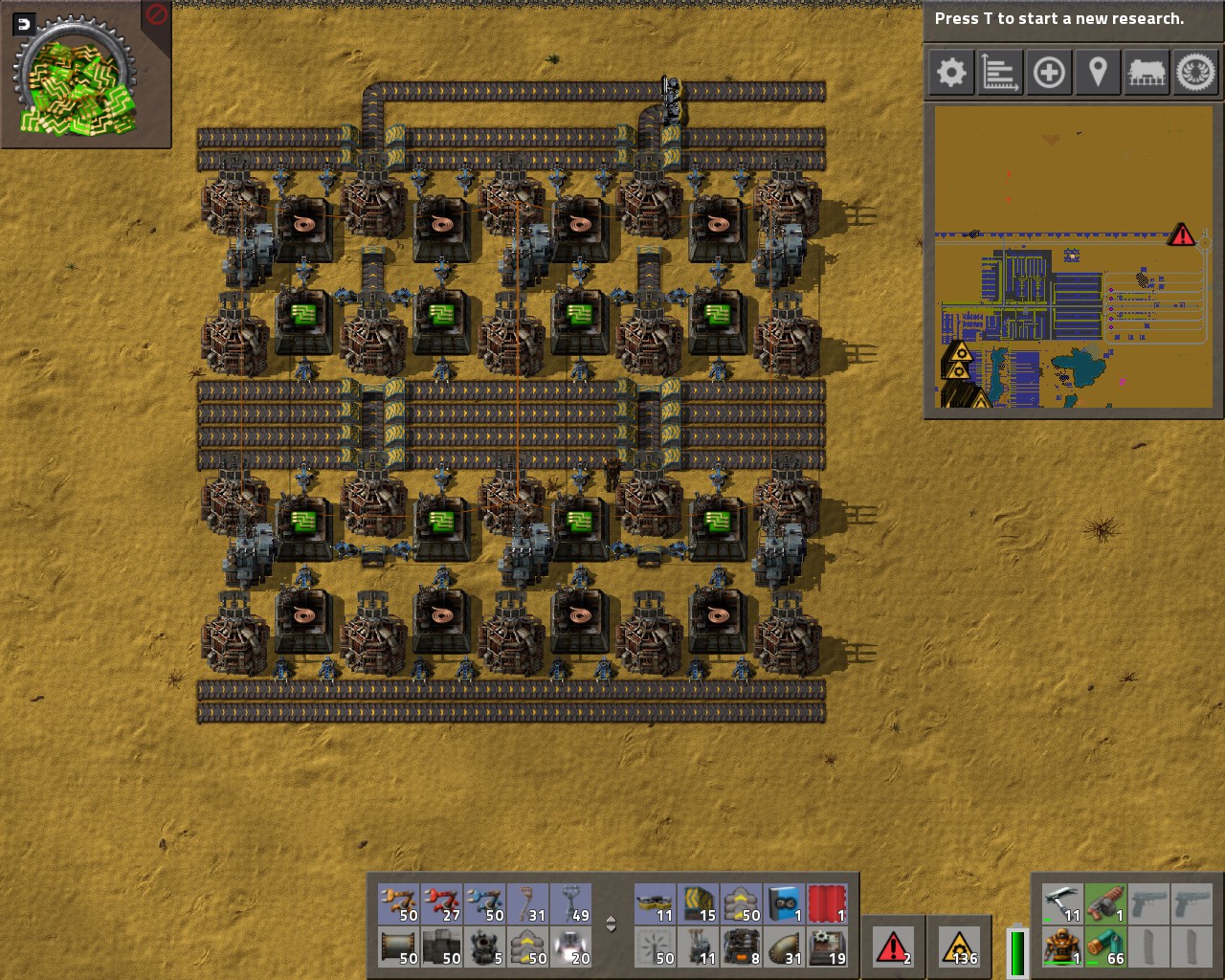
If you put productivity 3 modules in both assemblers, the ideal ratio of copper cable to green circuit assembler is close to 1:1.
At full load, this thing achieves about 2/3 ish compression on a blue belt. (full compression, when using the buffer storage)
It is pretty compact as im using a third less assemblers. Sure, the output rate of circuit assmblers is a bit slower per assembler, but you can compensate for this by adding another row and it is still very compact.
plus: The prod modules drastically reduces the stress on your infrastructure as you only need about 51% copper and 71% iron plate as usual per circuit.
Yet another green cells build :)
Forum rules
Circuit-free solutions of basic factory-design to achieve optimal item-throughput
Re: Yet another green cells build :)
- Attachments
-
- Clipboard02.jpg (478.46 KiB) Viewed 58883 times
-
brunzenstein

- Smart Inserter

- Posts: 1156
- Joined: Tue Mar 01, 2016 2:27 pm
- Contact:
Hi guys: Yet another green cells build :)
Hi guys!
I follow with astonishment your dedicated elaboration on the matter of green cells. One could/can learn a lot of things here.
My wish is that you would now move on to focus on heavy oil processing, cracking, lossless and economic use and transport of the resulting products.
Start a new subject on the matter of oil processing and transport (barrel or line) please -
Thats a problem for many as the fine- tuning of the output of the refinery site is not a so easy matter - at least for newbies like me..
I follow with astonishment your dedicated elaboration on the matter of green cells. One could/can learn a lot of things here.
My wish is that you would now move on to focus on heavy oil processing, cracking, lossless and economic use and transport of the resulting products.
Start a new subject on the matter of oil processing and transport (barrel or line) please -
Thats a problem for many as the fine- tuning of the output of the refinery site is not a so easy matter - at least for newbies like me..
Re: Hi guys: Yet another green cells build :)
brunzenstein wrote:Hi guys!
I follow with astonishment your dedicated elaboration on the matter of green cells. One could/can learn a lot of things here.
My wish is that you would now move on to focus on heavy oil processing, cracking, lossless and economic use and transport of the resulting products.
Start a new subject on the matter of oil processing and transport (barrel or line) please -
Thats a problem for many as the fine- tuning of the output of the refinery site is not a so easy matter - at least for newbies like me..
You could also start a new topic yourself and ask for advice/pictures/help (optional with your current build/idea/problems).

I'm pretty sure there are a lot of people who would love to help you improve your factory or teach you new things. And people who want to show their crazy builds are everywhere in this forum

-
brunzenstein
- Smart Inserter
- Posts: 1156
- Joined: Tue Mar 01, 2016 2:27 pm
- Contact:
Re: Yet another green cells build :)
I though about this too - but - as the level in this very thread is very high (at least for me) I abstained from posting my laymen's products not to spoil the quality.
Re: Yet another green cells build :)
I don't like those long handed inserters either. Too slow for most things. But they are easy to avoid with liberal use of underground belts.
I also don't like the thought of inserters moving things building to building.
If something somewhere backs up and green circuits aren't as high in demand, then the wire assemblers would also shut down, with a conveyor, the wires could still be moved to other buildings or a passive storage could be implemented in between the wires and circuits.
So, my solution:
It is kinda crazy, but I was squeezing it all into some empty space.
It's not the *entire* setup as wires also come in from a few other areas.
I also don't like the thought of inserters moving things building to building.
If something somewhere backs up and green circuits aren't as high in demand, then the wire assemblers would also shut down, with a conveyor, the wires could still be moved to other buildings or a passive storage could be implemented in between the wires and circuits.
So, my solution:
It is kinda crazy, but I was squeezing it all into some empty space.
It's not the *entire* setup as wires also come in from a few other areas.
- wires.jpg (280.47 KiB) Viewed 58810 times
-
vanatteveldt
- Filter Inserter

- Posts: 954
- Joined: Wed Nov 25, 2015 11:44 am
- Contact:
Re: Yet another green cells build :)
I was inspired by this design to try to "linearize" all production, ie have units that are as narrow as possible, and ideally can be "infinitely copied" (chained) to the side, that is, until the input belts are depleted.brunzenstein wrote:Very clever indeed!BlakeMW wrote:I sometimes use a "linear" design, something like this:
This is two units of green circuit production.
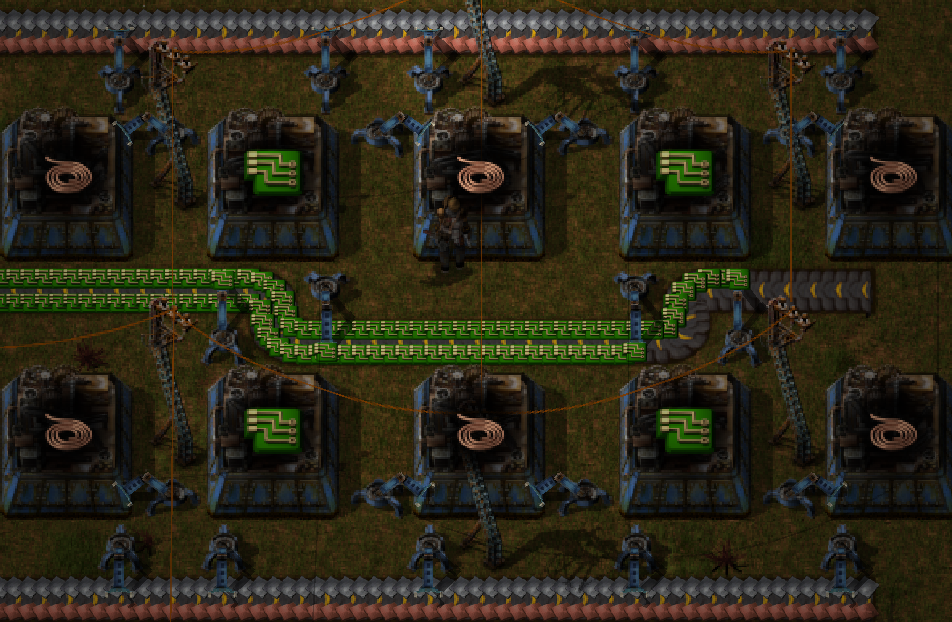
Since you need 1.5 copper per circuit, the two lanes of copper won't saturate a blue belt output belt completely (but probably good enough for me). However, you can easily untangle copper and iron if you add another belt above and below, and use an underground on the copper to allow the iron to reach the assmbler without long inserters.
In the same vein, this is my red+green science:
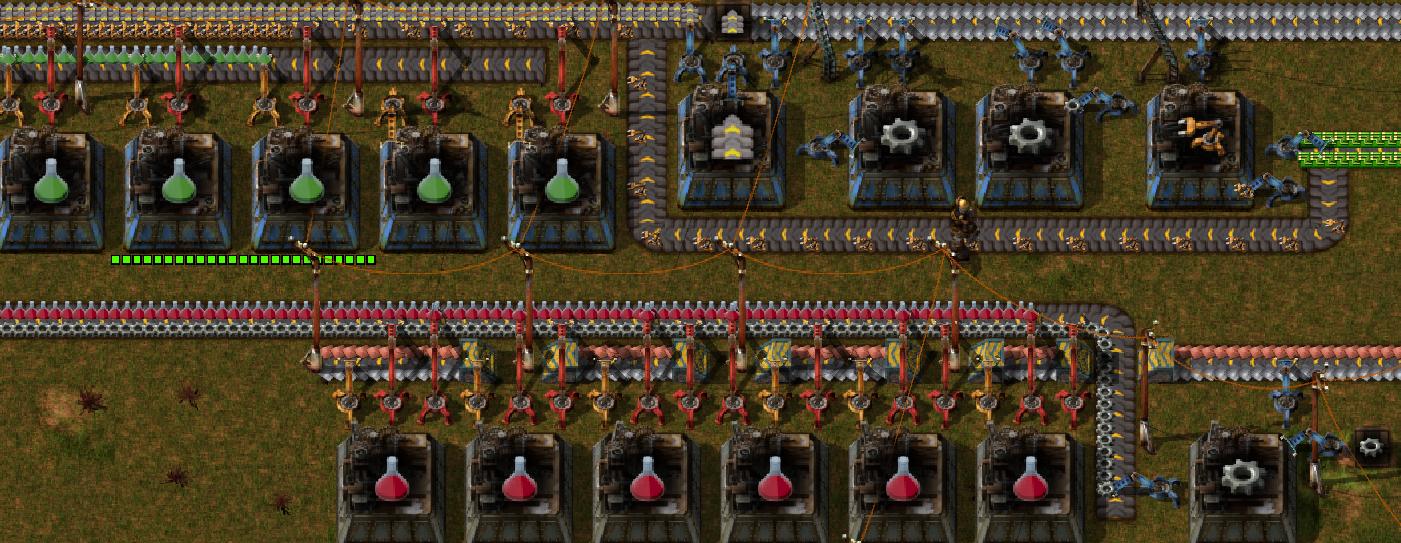
You can't chain the green science as is, but you could merge the iron with the output lane (just as I did with the gears for the red science) and that would make it chainable. As one green science requires 5.5 iron, a single blue lane would supper 20 green science assembly plants (at 1x speed), which is probably enough for most people

Edit: and finally red circuit production:
Inspired by the "space efficient red circuit" thread (viewtopic.php?f=8&t=18770#p122155), with as only "innovation" that I run the cable+output belt backwards so I don't need the return belt. The copper belt can be shared by a second units above the current one as you need copper, plastic, and green in equal proportions. Each circuit assembler needs 2 from each lane per 8 seconds, so I guess a blue lane of each input can support 80 assemblers at single speed, so you can chain 5 units horizontally.
Re: Yet another green cells build :)
This is my green cell build.
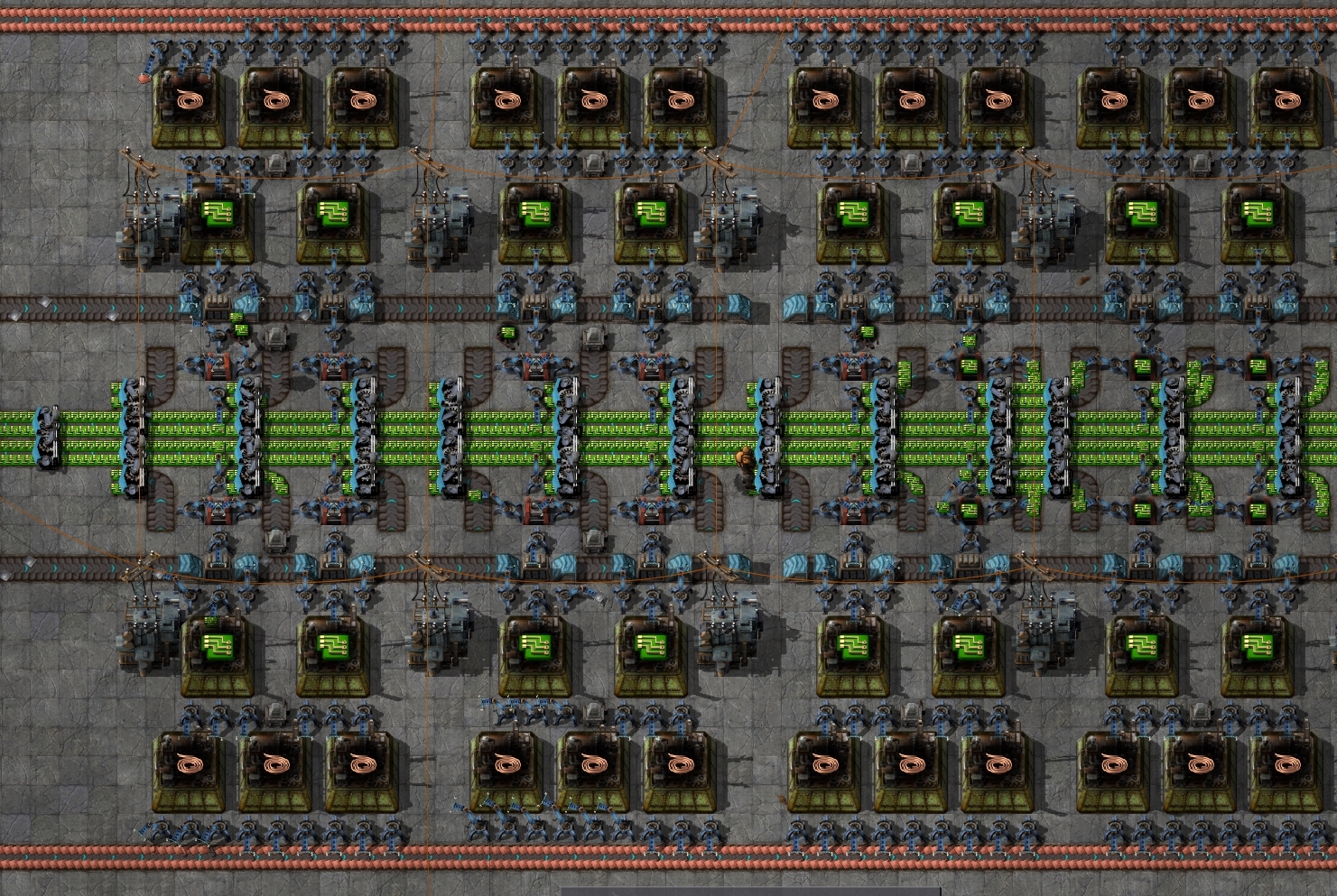
-
mooklepticon
- Filter Inserter
- Posts: 296
- Joined: Wed Mar 02, 2016 10:09 pm
- Contact:
Re: Yet another green cells build :)
Why go from assembler->steel chest->provider chest->bus?SJCubed wrote:This is my green cell build.
Re: Yet another green cells build :)
It's mostly for buffer storage. I could technically change the provider chest to just steel chest but it's in my blueprint so oh wellsmooklepticon wrote:Why go from assembler->steel chest->provider chest->bus?SJCubed wrote:This is my green cell build.

-
grouchysmurf
- Inserter

- Posts: 29
- Joined: Mon Sep 05, 2016 8:55 am
- Contact:
Re: Yet another green cells build :)
A necro, I know, but I wanted to brag about my approach nonetheless, hope you don't mind.
Like other people here I also don't like long inserters. What I also don't like is the asymmetry in the green circuit production -- 3/2 ratio renders unappealing pattern. While YMMV, I personally don't like the spacing it imposes.
Hence following layout:
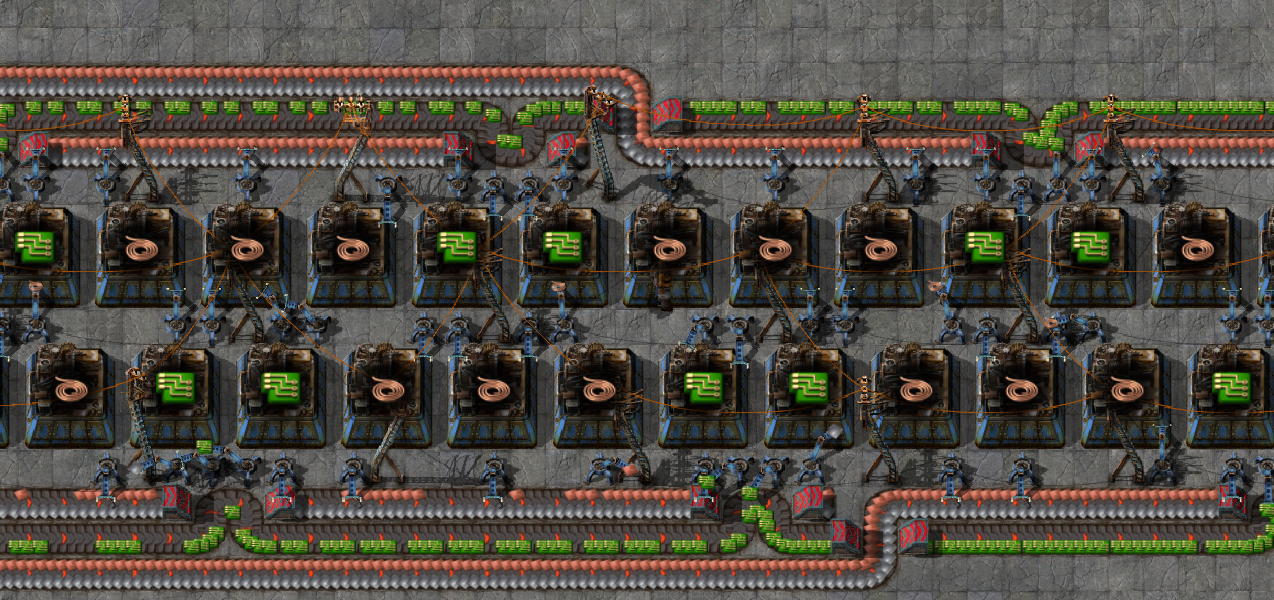
I assume use of level 2 assemblers with no modules:
Like other people here I also don't like long inserters. What I also don't like is the asymmetry in the green circuit production -- 3/2 ratio renders unappealing pattern. While YMMV, I personally don't like the spacing it imposes.
Hence following layout:
I assume use of level 2 assemblers with no modules:
- nine fast inserters starve out half-full compressed belt of copper so it needs to be fed in
- you need ~20 green circuit factories to saturize red belt.
blueprint string
Last edited by grouchysmurf on Tue Sep 06, 2016 5:30 pm, edited 1 time in total.
Re: Yet another green cells build :)
My late game green cell with no long handed inserters
- 20160906121710_1.jpg (641.76 KiB) Viewed 18015 times
-
LazyLoneLion
- Fast Inserter

- Posts: 183
- Joined: Sun Mar 20, 2016 11:49 pm
- Contact:
Re: Yet another green cells build :)
Not sure if you could have used big poles instead of staions and add few more beacons instead.Juggla wrote:My late game green cell with no long handed inserters
//nice design here
-
GeniusIsme
- Burner Inserter

- Posts: 15
- Joined: Sun Sep 28, 2014 7:26 am
- Contact:
Re: Yet another green cells build :)
Why ratio for heavily moduled assemblers is more close to 1:1. I've experienced this myself, but i have no explanation to the phenomenon. Both circuit and wire assemblers should be slowed down by the same amount, shouldn't they? But experiment shows that wire assemblers are slowed down more. Do somebody have a solution to this mystery?
Re: Yet another green cells build :)
Nope.GeniusIsme wrote:Why ratio for heavily moduled assemblers is more close to 1:1. I've experienced this myself, but i have no explanation to the phenomenon. Both circuit and wire assemblers should be slowed down by the same amount, shouldn't they?
Wire production (4 x productivity module 3 and assembler III: speed - 60%: crafting speed: 1.25 * (1 - 0.6) = 0.5)
Base output: 2 wires per 0.5 sec = 2 wires per 30 ticks = 1 wire per 15 ticks
With crafting speed 0.5: 1 wire per 30 ticks
With productivity 1.4: 1.4 wire per 30 ticks = 1 wire per 21.42 ticks
Green circuit production (4 x productivity module 3 and assembler III: speed - 60%: crafting speed: 1.25 * (1 - 0.6) = 0.5)
Base input: 3 wires per 0.5 sec = 3 wires per 30 ticks = 1 wire per 10 ticks
With crafting speed 0.5: 1 wire per 20 ticks
Ideal ratio is 21.42 : 20 or ~ 1 : 1
-
GeniusIsme
- Burner Inserter
- Posts: 15
- Joined: Sun Sep 28, 2014 7:26 am
- Contact:
Re: Yet another green cells build :)
Thanks.
tl:dr. They are indeed slowed down by the same amount, but resulting wire production is higher due to, well, productivity bonus.
tl:dr. They are indeed slowed down by the same amount, but resulting wire production is higher due to, well, productivity bonus.
Re: Yet another green cells build :)
I'm sure with a little finagling I could squeeze in a few more beacons. It's not fully optimized. But if I add more beacons I will also have to find a way to pump more plate in as well. In it's current incarnation I am almost using all material on the belt.LazyLoneLion wrote:Not sure if you could have used big poles instead of staions and add few more beacons instead.Juggla wrote:My late game green cell with no long handed inserters
//nice design here
-
MisterSpock

- Fast Inserter
- Posts: 102
- Joined: Mon Jun 16, 2014 8:11 am
- Contact:
Re: Yet another green cells build :)
I tried this independently.
Layout can be stacked 4 times with the 4 lanes each copper/iron.
Layout can be stacked 4 times with the 4 lanes each copper/iron.
Watch my new screenshots here: http://steamcommunity.com/profiles/7656 ... =imagewall

Re: Yet another green cells build :)
option 1 . Simple and linear, but there is a weak point - Long handed inserter
Option 2. Almost the same thing, but everywhere you can install Stack inserter and a little harder to extract the finished product
- 1а.jpg (1.74 MiB) Viewed 17367 times
- 1б.jpg (1.8 MiB) Viewed 17367 times
Re: Yet another green cells build :)
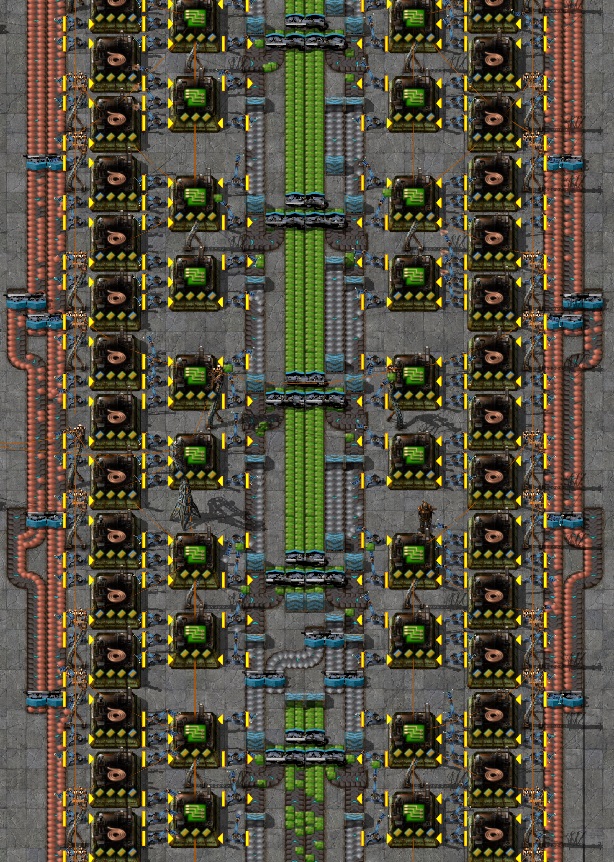
4 Belts Copper 3 belts iron 2 Belts green
Re: Yet another green cells build :)
Hey everyone!
There was a discussion on page one about using Productivity 3's with Speed 3 beacons and belts. This is where my post actually belongs to.
I recently tried to come up with a endgame design for green circuits without bots. As you can imagine, it became quickly clear, that the design was going to be pretty small, as there is not enough room to bring in material and/or remove products. My goal was to maximize assembler utilization for a linear layout I intended to use for every other assembler/furnace product as well.
There are recipes which are easy to satisfy with said layout, so I figured, I could try to belt in additional resources for the more demanding recipes in the lanes for simple recipes. This is the purpose of the following monstrosity:
Resources and products of the green circuit assemblers are brought in and out via two lanes of furnaces. This allows for 6 green circuit assemblers per half a lane (the design is mirrored along the vertical axis) instead of only 2.
As I tried to maximize utilization, neither inputs nor outputs are saturated belts:
I have not measured the output exactly, but I estimate that the compression is about 2/3.
If anyone wants to try it, here is the blueprint:
Happy 0.15 for tomorrow!
Proculis
There was a discussion on page one about using Productivity 3's with Speed 3 beacons and belts. This is where my post actually belongs to.
I recently tried to come up with a endgame design for green circuits without bots. As you can imagine, it became quickly clear, that the design was going to be pretty small, as there is not enough room to bring in material and/or remove products. My goal was to maximize assembler utilization for a linear layout I intended to use for every other assembler/furnace product as well.
There are recipes which are easy to satisfy with said layout, so I figured, I could try to belt in additional resources for the more demanding recipes in the lanes for simple recipes. This is the purpose of the following monstrosity:
- Overview.jpg (2.59 MiB) Viewed 17262 times
As I tried to maximize utilization, neither inputs nor outputs are saturated belts:
- Output.jpg (2.34 MiB) Viewed 17262 times
If anyone wants to try it, here is the blueprint:
blueprint
I added Requester Chests in front of each input belt to mark the required resource. Copper and iron plates are needed for green circuits. Instead of coal, you can feed in any ore (or iron for steel for that matter) you want. So far nothing unusual. Important is however the following: The two copper/iron ore chests mark inputs, that must be of the same type of ore (though not necessarily copper or iron), because the two furnace lanes have common outputs.Happy 0.15 for tomorrow!
Proculis