Page 1 of 1
Solar Power Ratios
Posted: Wed May 27, 2026 8:20 am
by GregFirehawk
I was looking at the wiki and can't seem to understand how they arrived at the ratio for solar panels to accumulators there. The solar panel has an effective uptime of 70%, and the remaining 30% needs to be buffered for when there isn't light. This gives an average power rating of 42 kW. So far everything makes sense.
If you actually calculate how much power you need to buffer though, its ~5.2 MJ, and the ratio of panels to accumulators is 1:1.0584. This is extremely different to what is written on the wiki, where it says the ratio is 1:~0.85. Can someone explain to me how the numbers can be so far off?
Re: Solar Power Ratios
Posted: Wed May 27, 2026 1:02 pm
by Tertius
You don't need to supply power for the whole dusk+dawn+night phase from the accumulator, just for the phase where solar panel output is below 42 kW.
dusk and dawn is 84 seconds each, night is 42 seconds.
We need to supply power for the dusk+dawn part where power is below 42 kW.
This is 70% power, so it is 70% of dusk+dawn, so it's for 0.7*84 = 58.8 seconds.
So we need to buffer for this 58.8 seconds of dusk+dawn and for the night of 42s to sustain 42 kW. Not for 84 seconds + 42 seconds.
energy = (58.8s + 42s) * 42 kW = 4233.7 kJ
Comparing this with the capacity of the accumulator of 5000 kJ: 4233.7 / 5000 = 0,84672
And this is the well known ratio.
Re: Solar Power Ratios
Posted: Wed May 27, 2026 3:25 pm
by Hurkyl
Is that 5:2:1:2 breakdown of the day-night cycle the same on all planets? I've had trouble finding any documentation on that.
Tertius wrote: Wed May 27, 2026 1:02 pmSo we need to buffer for this 58.8 seconds of dusk+dawn and for the night of 42s to sustain 42 kW. Not for 84 seconds + 42 seconds.
energy = (58.8s + 42s) * 42 kW = 4233.7 kJ
You're missing that the solar panels are sill supplying half of the energy during those 58.8 seconds as they scale linearly between 70% and 0% power.
But fixing that, the breakdown is (with "max power" being the daylight power generation of the solar panels)
- You spend 0.5 days during daylight, with 30% of max power going into charging the accumulators
- You spend 0.4 * 0.3 days during dusk/dawn, averaging 15% of max power going into charging the accumulators
- You spend 0.4 * 0.7 days during dusk/dawn, averaging 35% of max power being drained from the accumulators
- You spend 0.1 days during night, averaging 70% of max power being drained from the accumulators
So 0.5 * 30% + 0.4 * 0.3 * 15% = 16.8% = 0.4 * 0.7 * 35% + 0.1 * 70% of a day's energy needing to be buffered.
Re: Solar Power Ratios
Posted: Wed May 27, 2026 5:12 pm
by Loewchen
Re: Solar Power Ratios
Posted: Wed May 27, 2026 5:44 pm
by Tertius
Hurkyl wrote: Wed May 27, 2026 3:25 pm
Is that 5:2:1:2 breakdown of the day-night cycle the same on all planets? I've had trouble finding any documentation on that.
Tertius wrote: Wed May 27, 2026 1:02 pmSo we need to buffer for this 58.8 seconds of dusk+dawn and for the night of 42s to sustain 42 kW. Not for 84 seconds + 42 seconds.
energy = (58.8s + 42s) * 42 kW = 4233.7 kJ
You're missing that the solar panels are sill supplying half of the energy during those 58.8 seconds as they scale linearly between 70% and 0% power.
It's not missing. Look at the graph in the wiki and take into account we compute energy as the area of shapes (rectangles and triangles):
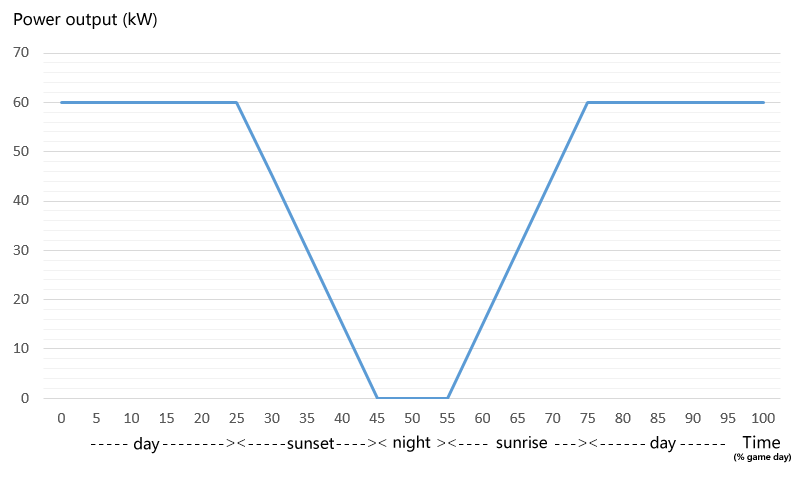
dusk is 58.8 seconds and dawn is 58.8 seconds.
We don't have to deal with triangles. Do a bit of cut+paste with paper and scissors, and you get this. Cut the triangle of dusk and paste it against dawn to get a rectangle:
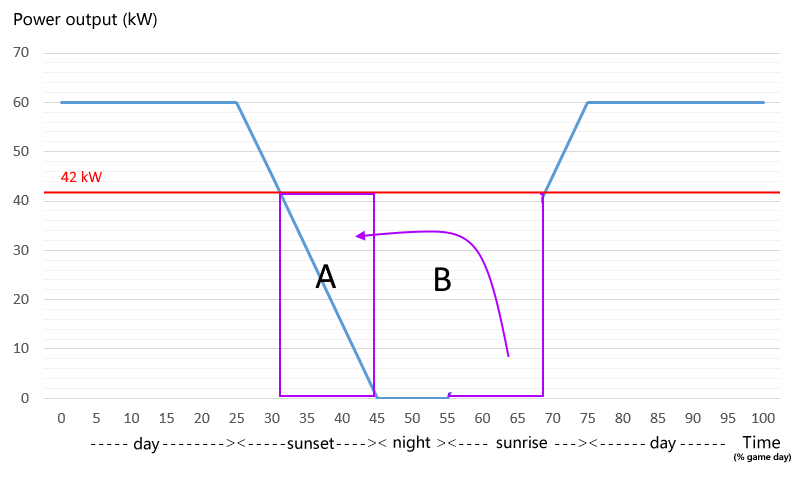
- 05-27-2026, 19-48-12.png (20.97 KiB) Viewed 1572 times
Now, area A is neither consuming nor charging the accumulator - it's balanced for the time of dawn (A). But dusk (night+B) is now completely supplied by the accumulator. This area is what we need as charge in the accumulator. Its length is night + length of dusk until 42 kW, which is 70%. This is the energy we need to supply from the accumulator, which is 42 kW * (42s + 0.7*84s) = 4233.6 kWs = 4233.6 kJ.
The whole energy collected by the solar panel can be calculated the same way, also cutting the triangle of the whole dusk and paste it to dawn to make it a rectangle, so the length of the whole rectangle is day + dusk (or dawn, but not both) = 210 s + 84 s = 294 s. The height is 60 kW, so:
energy production = 294 s * 60 kW = 17640 kJ.
At the same time consumption is the whole area below the 42 kW line.
This is the whole day+dusk+dawn+night (420 s) with 42 kW:
energy consumption = 420 s * 42 kW = 17640 kJ
We see, consumption equals production.
ps.
after looking at the wiki tutorial cited by Loewchen I have to apologize to ignore integrals but use just ordinary rectangles for area calculation. But it's really not that complicated. As far as I see, this tutorial page is too convoluted to be of practical use. A wiki article should be up to the point and not a lengthy monograph about a single topic.
Re: Solar Power Ratios
Posted: Wed May 27, 2026 6:05 pm
by Tertius
Hurkyl wrote: Wed May 27, 2026 3:25 pm
Is that 5:2:1:2 breakdown of the day-night cycle the same on all planets? I've had trouble finding any documentation on that.
According to a comment in
"C:\Program Files (x86)\Steam\steamapps\common\Factorio\data\core\prototypes\utility-constants.lua"
"C:\Program Files (x86)\Steam\steamapps\common\Factorio\data\space-age\prototypes\planet\planet.lua"
-- Should be based on the default day/night times, ie
-- sun starts to set at 0.25
-- sun fully set at 0.45
-- sun starts to rise at 0.55
-- sun fully risen at 0.75
All planets seem to have the same values. Although the color distortion at sunset/sunrise is different, it seems the day/night ratio relevant for solar panel power production is the same everywhere.
Re: Solar Power Ratios
Posted: Wed May 27, 2026 8:02 pm
by GregFirehawk
I made a more intuitive graph. If you look at the net kW line things become a lot more intuitive
https://wiki.factorio.com/File:Alternat ... _Graph.png
My mistake was I was calculating in net kW like you're supposed to, but I still did the integration off of gross kW, which is where the error comes up. With the net kW line on the graph its much clearer and simpler to get the numbers straight
Re: Solar Power Ratios
Posted: Thu May 28, 2026 11:31 pm
by Hurkyl
Tertius wrote: Wed May 27, 2026 5:44 pm
Hurkyl wrote: Wed May 27, 2026 3:25 pm
Is that 5:2:1:2 breakdown of the day-night cycle the same on all planets? I've had trouble finding any documentation on that.
Tertius wrote: Wed May 27, 2026 1:02 pmSo we need to buffer for this 58.8 seconds of dusk+dawn and for the night of 42s to sustain 42 kW. Not for 84 seconds + 42 seconds.
energy = (58.8s + 42s) * 42 kW = 4233.7 kJ
You're missing that the solar panels are sill supplying half of the energy during those 58.8 seconds as they scale linearly between 70% and 0% power.
It's not missing. Look at the graph in the wiki and take into account we compute energy as the area of shapes (rectangles and triangles):
Then the explanation was missing that you were doing a manipulation to rewrite "a part (which turns out to be half) of 70% of dusk+dawn" with "all of 70% of just one of the two".
Just to be clear, I wasn't disputing the conclusion, just that the textual explanation was the wrong thing. And wanted to give an explanation that was free-of-tricks in a situation that can confuse people.
We don't have to deal with triangles. Do a bit of cut+paste with paper and scissors, and you get this. Cut the triangle of dusk and paste it against dawn to get a rectangle:
As an aside, it's interesting how different approaches click with different people. E.g. I've dealt with 'triangles' in this sort of context enough that sticking in the "average" factor of 1/2 so basic it didn't even register to me that it was a trick, and while I think this sort of geometric argument is neat, it's the more complicated method in my mind.
I bet the author of that wiki page didn't even register that expressing things as an integral is complicated to people who aren't fluent in that language.
Re: Solar Power Ratios
Posted: Fri May 29, 2026 7:54 am
by Tertius
Hurkyl wrote: Thu May 28, 2026 11:31 pm
As an aside, it's interesting how different approaches click with different people. E.g. I've dealt with 'triangles' in this sort of context enough that sticking in the "average" factor of 1/2 so basic it didn't even register to me that it was a trick, and while I think this sort of geometric argument is neat, it's the more complicated method in my mind.
It seems everybody has their own method to approach math - it's an abstract topic after all. I assumed the geometric approach is the most simple, but it seems this is an error on my side. I don't see integrals (written as formula as in the wiki article) as obvious solution here, because solar power production in Factorio is a non-continuous function, so you have to deal with the separate parts anyway. The most simple integral is when the area is a rectangle. You just have to multiply the 2 sides. So I try to patch (in my mind) 2 similar triangles together (if they exist) to get one rectangle, so just have to add the area of a few rectangles to get the whole value.
Re: Solar Power Ratios
Posted: Fri May 29, 2026 5:00 pm
by Hurkyl
Tertius wrote: Fri May 29, 2026 7:54 am
Hurkyl wrote: Thu May 28, 2026 11:31 pm
As an aside, it's interesting how different approaches click with different people. E.g. I've dealt with 'triangles' in this sort of context enough that sticking in the "average" factor of 1/2 so basic it didn't even register to me that it was a trick, and while I think this sort of geometric argument is neat, it's the more complicated method in my mind.
It seems everybody has their own method to approach math - it's an abstract topic after all. I assumed the geometric approach is the most simple, but it seems this is an error on my side. I don't see integrals (written as formula as in the wiki article) as obvious solution here, because solar power production in Factorio is a non-continuous function, so you have to deal with the separate parts anyway. The most simple integral is when the area is a rectangle. You just have to multiply the 2 sides. So I try to patch (in my mind) 2 similar triangles together (if they exist) to get one rectangle, so just have to add the area of a few rectangles to get the whole value.
To defend the person who used integrals, the idea of computing the result as the area under the graph is
itself a 'trick', since what we're really after is accumulating a rate over time, and an integral is probably the
direct mathematical expression of what is to be computed, other than the actually breaking things down tick by tick instead of the continuous approximation. So the integral isn't invoked to suggest doing a computation with algebraic manipulation via integral rules, but instead to express the thing we are actually interested in.
